iNaturalist observations

Thursday, November 17, 2016

Ravenna, Journal #7: 11/17/16

Thursday, November 17th, 2016
12:30 PM
Mostly cloudy, patches of blue sky
Dark and light cloud cover
49 degrees, very cold breeze that comes through about every 2 minutes


Phenology Update:
Holy cannoli, it's getting colder! There's a crisp chill that is definitely a harbinger of winter. I can feel it in my fingers and toes the most. On top of the chill, I'm getting sick, so this journal might not be a shining star of an entry. It's definitely a take the elevator, ride the bus kind of day. 

At the site, the feathers are still there, and the ground is still extremely mushy. I feel like there's more bird song than usual today, but that's probably just because I've started to pay more attention. I heard a woodpecker foraging for food- I soft pecking, not the loud signaling pecks. 

It's looking pretty sparse and barren here. 


The Rubus spectablis plants are falling over and dying.


All of the Athyrium filix-femina are basically gone, and the Polystichum munitum is even more shriveled than last time. 


My 1 meter investigation reveals similar findings as last week-the feathers are withered, and the leaves are more brown. Nothing really unexpected. 


Detritus isn't really unusual in mid-November. What is unusual is that it's just starting to get colder! We've usually had our first frost by now. Lucky for our fungus unit, I guess! 

Part II: Fungus Foraging and Looking for Lichen!

Specimen #1: A "flowering" fungus, about 2.5 inches tall, the cap is about .75 inches high, conical in shape, with a .5 inch diameter. The mushroom is brown, and fades from a light-brown on the outside edges to almost black towards the center of the cone. The stem is very thin. This mushroom is growing in a patch of moss in a marshy area at my central spot. It's closest to a Thuja plicata, but I don't know if it's a mycorrhizal fungus. This mushroom was here last week, but not two weeks prior. It stands alone, not in multitudes. 


Specimen #2: I think this is the dust lichen. It's growing with moss on the outward-facing side of a limb on a Taxis brevifolia, which is growing right by a slow-moving creek. I think this is crustoce. The tree is fairly wet- the bark looks very damp. 


Specimen #3:  This is a ghost white mushroom with very similar features to specimen #1. However, this fungus is much smaller, at about 1 cm tall. It's growing on the same Taxis brevifolia as specimen #2, on a limb where there isn't a whole lot of moss growing around it. This specimen is growing alone, not in a patch. I liked this one a lot, definitely wanted to show how small and delicate it was.


Specimen #4: Very fine mint-green crustose on my central Thuja plicata, growing closer to the ground than to the top of the tree. The growth pattern is minimal and patchy, but circles around the whole tree. There is more of it growing on the side facing uphill. I wonder if this has anything to do with moisture flowing downhill? 


Specimen #5: Bleach-white crustose that looks like bird droppings. It grows on the underside of Rubus spectabilis plants, where there is exposed bark, and no other limbs extending from it. The Rubus spectabilis hangs over the stream. 


Specimen #6: This one is kind of confusing. I'm pretty sure it's a fungus. It grows with moss that heavily coats an Acer macrophyllum, on the East side of the tree. The growth looks like rings/crescents that are about the size of a soccer ball. The crescents have two layers- the outer layer is lighter, and the inner layer is darker. The tree is at the bottom of a ravine. I wonder if sunlight from the East has anything to do with its growth patter. It seems to be like a mold that is inoculated onto the moss. 


Man, I'm tired and cold. Time for lunch! See you next time, Ravenna. 


Sunday, November 13, 2016

11/10/16 Ravenna Entry #6

November 10th, 2016
12:05 PM
Equal parts sunny and hazy sky
61 degrees, very little/no breeze

Phenology Update:

Nothing as drastic as the last two entries, but the brush on the forest floor is very brown, maybe more decayed than last time; can't really quantify that information at this point. I think more leaves have fallen off of all the Rubus spectabilis plants, and the outer limbs of the Polystichum munitum are succumbing to winter's clutches. There are still maple leaves hanging from the Taxis brevifolia, and from the Thuja plicata. I'm making extra effort to use Latin names today. I think it might be the lighting, but moss hanging from all the trees seems to be illuminated-maybe more of the leaves have finally decayed, allowing the emerald surfaces to contrast with the browning Earth below. That last sentences seems a little too artsy for my taste. The ground is spongy, which is strange because it's been pretty dry this week. 

Picture of my go-to place


Maybe this stuff is finally dying?? (The salmon-berry shrubs)
 

I swear it's not my mind playing tricks on me, the moss really is glowing today!


The fun stuff is happening at the 1-meter scale of my spot. Some helicopters (maple tree seed droppings) and leaves litter the site. A new mushroom has appeared in the center. 


As I examine, I notice something new. Strange tube-like structures jut out from the outer edges of the mass of the covered root-base. They seem to be roots of some kind; they are similar to bean-sprouts in appearance and touch- smooth and kind of vine-like. Ones closer to the ground are brown, and the ones farther up are a whitish-peach color. 


BUT WAIT 

It's so ironic that this week's assignment is about birds, because the main thing that's covering my 1-meter site is... BIRD FEATHERS!

They've been compromised by moisture, so they're a bit shriveled, and they're very small. I think they're part of the under-layer of feathers, meant for insulation, and are definitely not meant to get wet. 

Overview of the site 

Closer view of the main feather deposit 

I also found what I believe to be bits of skin. 


Only one full feather was dropped-it's about five inches long, where the vane of the feather only covers four. The feather is pretty wet, so it's hard for me to tell what shape it might have been (for identifying what part of the bird it came from). 


Based on the clues, I think the bird was preening here. But that's weird, because this is kind of an exposed area for a bird to be doing something that would make it so vulnerable. Maybe something was eating it? But then there would be more full flight-feathers left that would have been removed for digestion?? Very strange... 

PART 2: Bird Watching

When I first reached my site, I think I alarmed some chickadees- they started their call with a few high pitched chirps, followed by their iconic "dee-dee-dee". The number of "dees" seemed to vary between odd numbers, but I can't be certain. It might be hard to follow a bird here, because I make too much noise when I move, and the foliage is pretty dense. But I'll try my darnedest. I saw two hummingbirds flitting about a conifer, and I think I heard the tail feather noise. 

I finally found a black capped chickadee in a deciduous tree! It flew back and forth between a cedar tree for about five minutes, before it flew into the brush, and I couldn't find it again. It's flight style was heavy and frequent- they don't sit still that much. It's wing beats were kind of frantic in order to keep its round body up in the air. It hopped around the main trunk and branches of the Thuja plicata, poking holes in bark to get food. I read up on these birds after I got home, and found that half of their diet during the winter is insects and other animal food. So I assume that the chickadee was poking around for inverts to eat. When it grabbed for food with its beak, I saw it simultaneously flick its tail. Chickadees are super acrobatic, and I was witness to this when the bird hung upside-down from a branch in order to poke at it. 

When I got home, I watched  mini-documentary on chickadees because I'm a huge nerd. I found out that chickadees carry their food away from the site they procured it in order to eat. So that's why they always look so busy at bird feeders! Also, they cache their food in the fall, so that's another possibility for what my specimen was doing. 

Here are my four figure sketches-they're pretty small and not very good, had to do them from memory


PART III: MISCELLANEOUS


Okay, so I felt that I should write something about this election. I woke up in the morning, and my first concern was about the environment. Humans can fight for humans, but the biosphere has far less of a voice. I'm so worried about the pipeline. I'm scared that the EPA will be turned into a joke.But when I enter the woods, my nerves turn into determination. In the words of Pramila Jayapal: "This is not the fight that I would have chosen, but I will fight it." I want to work hard, learn what I can, and make sure that the next generation gets to walk through the woods, frolic by the water, and breathe clean air. 


Wednesday, November 2, 2016

Ravenna Park Entry 5: 11/2/16

November 2nd, 2016
Wednesday, 3 PM
Cloud cover and rain
~55 degrees


     The drizzle barely descends through the canopy, so it feels like the leaves are just letting go of water from earlier in the day. I came a little later than I would have like, but I'm glad I didn't make it any later in the day. 
     Everything is gone! You can see the trail now, because all the leaves are soggy, and look like soiled paper towels. My Taxus brevifolia looks like a drying rack for these damp and droopy leaves.

Clear trails!


The Pacific Yew 
 

My central spot actually has puddles because it's been raining so much. Plants that are less than two feet tall seem to be drooped towards the ground-flattened-especially towards the marsh area that extends from the right and left of my central Thuja Plicata. The leaves at the tops of the salmonberry bushes are finally yellowing, when they were bright green last week. My strange marsh plants will probably be gone by next week- I'm strangely sad to see them go. Almost all of the lady ferns are brown. The horsetails are fallen over- I never knew that they decayed at the same time as other plants. The green that remains really contrast with the burgundy-brown of the fall droppings ( I'm just really tired of saying dying leaves). The moss at the base of the central cedar seems to be melting into the Earth, as if something extremely heavy has sat on every single section of moss that's covering the roots. All the mushrooms are gone as well- I'm not sure if the loss is due to humans. 

General picture of my site 

Picture of the mossy base area
    

 Fun find: HUGE salmon berry leaf, coming from a bush that has grown about seven feet off the ground, and has started to come into conflict with the droopy branches of the Western Red Cedar. 


PART 2 POETRY 

20,000 Millimeters Under the Dirt:

Burrow, bury, dive
Under-not over
Hide in the muck
Cower in the mire
Old to New
Can tell just by the looks of you
Your home dies
Your body
Fleshy
Like a newborn. 
You
So vulnerable
Writhe in the sunlight
Yearn for a way to escape the bright
and arid 
Land above. 

Prayer to the Cedar:

Mother
Lend your arms to us
Let your fingers dry our tears
Let your loving arms hang low
to reach us
we
Who seek comfort
From rain
From cold
Your arms embrace us
and your blood
flows
through us. 

Prayer to the Stewards:

Give me oak and give me pine
Let these forests stand the test of time
The way summer comes so slowly
But then flees so fast
'til death do us part or until 
Winter leaves at last
Thaw these bodies
Thaw these hearts

Post Party Blues:

Sodden napkins litter the living room
The ladies are crying in a drunken stupor over their dates who went home with someone else
Chairs are toppled over
Wine soaks the carpet
The air smells sweet
The remnants of a beautiful person
that left 
Only two hours ago. 


First is about a worm, second is about the western red cedar, the third to all of us, and the last on the approaching winter. 


Wednesday, October 26, 2016

Entry 4: 10/25/16

October 25th, 2016
2:25 PM
63 degrees, scattered clouds but mostly sunny
No wind

     I thought there were leaves on the ground before, but golly! The river is full of leaves, and the forest floor has turned into a crunchy brown and orange carpet, where nothing can move without producing noise. My primordial instincts put me on guard, because leaves falling behind me make the hair on the back of my neck stand up, as if someone is right behind me. The maple trees are the main perpetrators, and their decaying leaves hang in plants they don't belong to- it looks as though my Pacific Yew has turned into a big leaf maple! Here is a shot of my central spot. I think it looks fairly different from last time!


     The lady ferns are more decayed than two weeks ago, and only the tallest reaching leaves of the salmon berries remain (they're surprisingly green a well). The brown leaves of the marsh plants from last time have decayed completely- only droopy green leaves splay out from the main shoot.


Everything is dying, but it seems less of a sloppy and droopy mess. I'm not really sure how to describe it. It's a crisper death? 

     For clarification, my small area for phenology observation is pictured below:


     Since I've been here last, this small patch of moss has become a haven for detritus! cattails, cedar droppings, and leaves from salmon berries and maple trees have started to pile up. The leafier moss has all but dissappeared, and only the hairier moss remains. My guess is that it's Menzies' moss (but I could be super wrong about that). Some new mushrooms have popped up too. How long does it take for a mushroom to fully develop?


NOW FOR THE INVERT INVESTIGATION!!

There's a lot of evidence of the existence of inverts here. There are bite marks and trails on most of the plants that I can spot.
I sit for a while, trying to be as still as possible, while looking at the ground for any sign of movement. I started to lean closer towards the ground as I sit criss-cross apple-sauce in the grass behind my central cedar. I find a small lump of a slug curled up on a leaf. I think I startled it when I sat down. As I watched it, I noticed a thumbprint like pattern on its mantle, and a hole farther down for breathing. The upper tentacles guide the slow moving slug across a leaf, where it extends from the front to the back, in order to maintain balance on its leaf. The variation in surface area of the slug plays a vital role in ensuring that it doesn't stumble or fall. I never realized that even a blade of grass is an obstacle in the world of inverts. The slug contracts when it is alarmed, and the tentacles also retract.


My next invert was a little harder to view, just because it was very small and moved fairly quickly. It had six legs, and was about the size of my thumbnail. It moved faster when it was alarmed, but stood still for a while when it was calm. It had a hook like projection that reminded me of the mouth of a butterfly. The wings were very large in proportion to its body, but I don't think it could fly-otherwise it would have flown away from me when I startled it. The bark patterned wings are perfect for camouflage, because they are very bark patterned. The antennae helped it avoid obstacles, much like the tentacles of the slug. Its overall body shape is super tear-dropped, and its legs are striped.
Due to the flat abdomen, and the sucking mouth part, I think this bug is part of the Hemiptera order.


I was having a hard time trying to find more critters, but I luckily found a log near the "entrance" of my site. I found an earthworm! It moved like a slinky- front first, and everything else scrunched forwards to catch up with the head. The head is the end closer to the big lighter-colored projection, which I found out is called the clitellum. As I watched it move, I noticed that it would much rather go under debris, not over, which is not what its close cousin the slug would do. This must have to do with the fact that earthworms travel underground, and slugs do not. The worm was darker at one end than the other- I wonder why that is? The earthworm was probably 3 1/2 inches long.


Then, I found a millipede! It was about an inch long, and it was light in color- I wouldn't say white, but definitely a sandy color. I know it's kind of taboo to do, but I picked it up. I honestly thought it was dead, because it didn't move and didn't respond to touch for a solid minute. I moved it, and I couldn't tell if it was coiling up on its own, or if I was the one causing it to coil. After sixty seconds, it uncoiled, its antennae popped out, and it started to crawl around. I want to understand how it moves- does every other leg on the same side move in an opposite motion? It was too small and quick for me to tell. I couldn't get any more specific than the class of this millipede.


Well, it was fun to hunt for inverts this week. I can't wait to visit again next week!


Wednesday, October 19, 2016

Weeked trip 10/15-10/16

There’s so much to write! Who knew two days could be so densely packed! I rode in a van with Kaeli, Elizabeth, Ella, Devin, and Tim.

Nisqually River Delta Visitor Center:
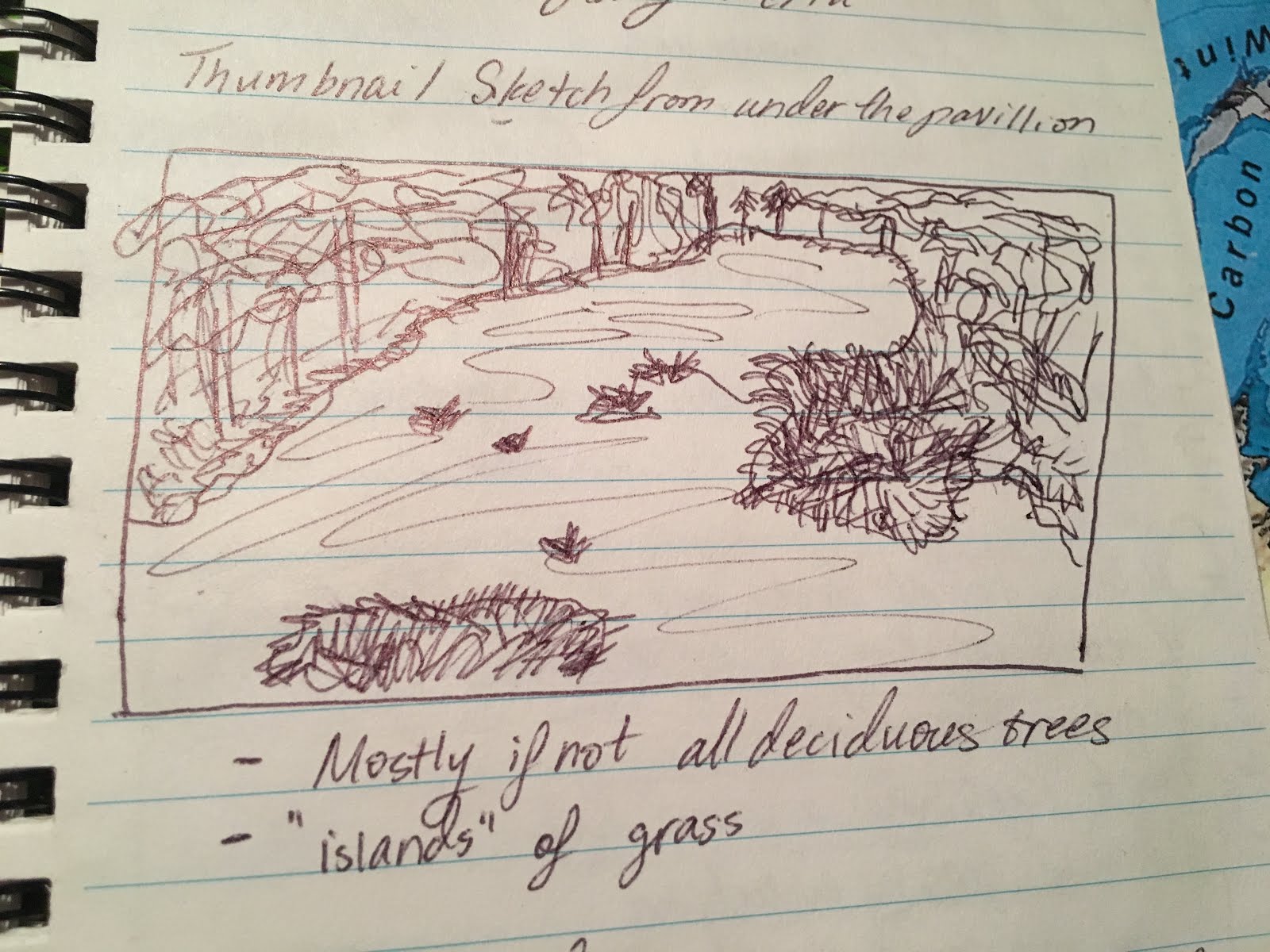
We arrived at the Billy Frank Jr. Nisqually National Wildlife Refuge around 9:00 AM on October 14th. As we unloaded from the vans, we were met with a drizzle that would persist off and on for most of the day. The temperature was probably around 50 degrees, so it was not at all of a shock to any of us. We walked about 150 meters to the Visitor center, which overlooks an oxbow lake. We spent about an hour under the pavilion, looking through binoculars and scopes, identifying birds we spotted. Below is a thumbnail sketch of the lake, which also extended and meandered off to the left of my sketch.


The lake was characterized by a shoreline of grasses and cattails, and a tree line no more than 2 meters from the main shoreline. There were also small “islands” of grasses interspersed on the lake. In fact, the lake doesn’t have much bare surface area; it is very marsh-like, with grasses popping up even in the middle of the lake. The trees growing along the lake shore are deciduous-mainly big leaf maples (Acer Macrophyllum) and red alders (Alnus rubra).
I researched a bit about the Nisqually refuge, and I found out that the permanent freshwater oxbow lake is a not a natural oxbow lake, but was built in 1970 by manipulating water from wells around the Brown Farm. However, the Billy Frank Jr. Nisqually refuge is the largest tidal marsh restoration project that has ever occurred in the Pacific Northwest, where 762 acres were reconnected to the Puget Sound ecosystem by removing dikes in 2009. This restoration project increased the potential salt marsh habitat in the southern reach of Puget Sound by 50%.
Wetlands have extremely high species diversity, and we were witness to that. The Nisqually delta is a haven for many kinds of birds, especially water fowl. This is due to the high concentration of microorganisms in the shallow water. We saw five different species of birds at the lake, which included the Ring-necked duck, the American Wigeon, the Pied-billed Grebe, and the American Coot.
There were two ring-necked ducks together, a male and a female. The male ring-necked duck is easily identified by the distinct white ring around its bill, peaked head, and black body with gray sides. The females are brown, but also have the same white ring around its otherwise black bill. They are a diving species, and seeing them dive in the small pond was fun, because I would try to pinpoint where they would pop back up.
Not five meters to the right from the ring-necked ducks was a trio of three different bird species; the American Wigeon, the American Coot, and the Pied-billed Grebe. We identified the wigeon by its black tail feathers, white crown, and its white bill. The coot was distinguished by its black body, orange eye, the way it swims like a chicken, and its beak (not bill). The chunky bill, “cut off” rear, fuzzy look, and compact body helped us pinpoint the grebe.  The wigeon looked significantly larger than the other two birds. I thought it was really surprising that they were all huddled together. A theory for this is that when the grebe dives, it dredges up food for the Wigeon and Coot.
To our left, we saw a flock of Cedar Waxwings in a red alder tree with orange leaves. The Cedar Waxwings were very beautiful, but they looked kind of like bandits with the black markings around their eyes. Their heads have the same feather growth as a Steller’s jay, with the crown that extends beyond the back of its head. The waxwings had really gorgeous orange highlights on the wings and around the head.  
To the right of the waxwings, a couple of Starlings were perched on a snag. I found out that Starlings were introduced to New York. They were introduced by someone who wanted every bird found in Shakespeare’s works to be available to birdwatchers in the United States. I learned that Starlings are an invasive species that take over habitats like snags that would be perfect for native species. Kaeli also told me that Starlings are the birds that create intricate patterns of flight, which are called murmurations. 
Overall, the biodiversity of the freshwater wetland we observed was due to many factors. The generally mild temperature and shallow water create a perfect habitat for birds to feed and rest, and the foliage provides good hiding spots as well. This would not happen if this area had not been restored, allowing the oxbow lake to exist with maintenance by refuge staff.

Nisqually River Delta Twin Barn/ Estuary:
Next, we walked from the visitor center down the trail towards the division of the freshwater and saltwater marshes. At the beginning of the trail, we saw a Northern Flicker foraging on the ground to the left side of the trail. It was about 75 meters away from our group, and with our binoculars, we could see its beautiful spots and red cheeks.
We continued towards the twin barns, where we walked past a large open wetland plain, with a sparse tree line about 500 meters away from us on the left, where we could see at least a hundred birds resting in front of them.  We paused to look through the scopes. We saw flocks of Canada geese, pintail ducks, mallard ducks, and cackler geese. When we were identifying the wigeon from earlier, I almost mistook it for a pintail, so it was fun to see the difference between them. Pintails have very long and elegant tail feathers! Kaeli was the one to tell us that the Cackler geese weren’t actually Canada geese, and are identifiable due to their shorter necks. I also saw a Great Blue Heron resting by an alder tree, and two bald eagles closer to the barns. Then, we saw a Harrier Hawk flying above. We were able to catch a glimpse of the unmistakable white patch at the base of its tail. The wide open space allows huge flocks or birds to rest together, which is not possible at the enclosed lake by the visitor center.
Picture of the wetlands where the birds rest

Sketch of the Alder Trees where two bald eagles sat
 

At the grassy area to the right of the barns, there were tons of tree frogs. The frogs varied in color, from brownish to bright green. Individual frogs change color due to temperature and moisture content in the air. They come down from their homes in the trees in order to mate, which is why we found so many frogs hopping in the grass. They were really adorable. I never get tired of seeing tree frogs.
                               

Then, the group headed up the trail towards the division of the salt and fresh water marsh. The landscape was bare, with snags and grassland in the foreground, and mud flats in the background. As soon as we turned onto the trail, we saw a black tail doe feeding on the plants to our right on the right side of the trail, about 50 meters away. Then we turned left to view the estuary. Estuaries provide rich nutrients that occur due to the mixing of the freshwater from the river and the saltwater from the Puget Sound. I’m interested to know if we were seeing a low and high salt marsh. It was kind of far away to tell. Lots of invertebrates live in the mud flats, so many sea birds flock to feed there. We couldn’t see any of the birds from where we were, but the kind of birds that would be feeding include sand pipers and dunlins.

Picture of our view of the estuary 
 

MIMA MOUNDS:
We drove about 45 minutes to get to the Mima Mounds, where it was raining when we got there. From an observation point, we could see the massive sprawl of the mysterious pimple mounds. The oak savanna ecosystem of the Mima mounds is one of the last to exist in Washington State, and is maintained by humans in order to preserve the unique species that only live in the oak savannah. Historically, oak savannas were maintained by Native Americans through burnings. The land was used to plant food, such as the camas plant. Some question the reasons for specifically burning the oak savanna, but the reason is probably that the foliage of the prairies catches fire easier than that other vegetation zones.


The real mystery is how the mounds got there. Theories include recession of the Vashon glacier leaving sediment from sun spots, fluvial deposition from vegetation and flooding, erosion, earthquakes, giant gophers, and volcanic eruption. The soil is different and younger than the glacial till below, so it can’t have anything to do with the glacier, and there are no layers in the soil, and the gravel is randomly dispersed, so it can’t be due to fluvial deposition. There is a trace of volcanic ash in the soil, but it wouldn’t make sense for the mounds to be so even in size and placement. I have a theory, but it’s kind of out there. I believe that Native Americans built the mounds for some unknown purpose. We know they aren’t burial mounds, but they could have been built for some cultural purpose that we don’t know about. So much of Native American culture has been effaced since the time of white settlers that it is possible that the reasoning for and the tribe who built the mounds disappeared with time or disease. Local tribes don’t have legends of the mounds, but maybe there was a reason to not talk about the mounds. No natural causes make sense- they all have huge loopholes.
We walked out onto the prairie, where the rain stopped.
I noticed that ferns tend to grow on the North side of the mounds, although that’s not always the case. It’s hard to say if vegetation patterns due to location on an individual mounds actually occur. There’s shading from the forest, and shading from the other mounds around. One growth pattern I noticed was that the reindeer lichen never grows on the very top of a mound; only in between or on the sides. I believe that this is due to the fact that the tops of the mound get too much sunlight, and the moisture flowing down the mounds is more conducive to its growth. I identified several plant species that grew on the mounds, including the Oregon white oak, yarrow (which smells absolutely heavenly), harebells (so delicate and dainty), kinnikinnick, lupines, and lady ferns. The lady ferns were reddish brown in their decay, and the kinnikinnick bore berries. The soil was course, and full of rather large gravel chunks. I learned that lupines are nitrogen fixing members of the pea family. This is a hint to the fact that the soil may lack Nitrogen on its own. I researched a little about oak savannas, and they are characterized by poor soil. Makes sense!
Mima Mounds: Quarry and exposed mound
We walked into a quarry, where we could see the gravelly deposits left by the Vashon glacier, where we could distinctly see the sediment layers formed by glacial rivers. Some layers had heavier sediment than other layers, due to the swiftness of the stream during different years and seasons. Then we walked about 300 meters to the exposed mound, which looked completely different than the layers of the quarry. In fact, there were no layers. I could see where the glacial till stopped, and where the mounds began. The soil was darker, and the gravel and sediment had no pattern in placement. All of the rocks were relatively the same size, but there was no indication of fluvial deposit. This totally adds to my theory! If Native Americans built the mounds, then the soil would have to have been churned up, therefor destroying any previous deposit patterns. The Mima mounds are very spooky. Almost as spooky as Tim’s hairdo!


We left the mounds around 2:30 PM in order to beat the “storm”. We drove to pack forest. I am in love with pack forest. I could live there. 


DAY 2
I woke up at 5:45, and it actually wasn’t horrible. We went out to the parking lot where the vans were, and we looked up into the trees. Tim called for a pygmy owl. I learned that when you’re trying to lure birds, you should always start with the smallest calls first. Pygmy owls are fairly territorial, so they will check out what’s going on if they hear another pygmy owl on their turf. Unfortunately, it was pretty rainy and windy, so the owl never came down. However, there was more than one pygmy owl, and we might have started a scuffle, because they started calling back and forth to each other!
We headed for the mountain at 8:30, and we stopped at the Kautz creek landslide location. In 1947, heavy rain resulted in a debris flow that tore down old growth forest. We could see remnants of the old forest and the debris, where old logs and large boulders littered the forest floor. This new forest had some key characteristics: Young Douglas Firs make up the canopy layer, effectively blocking out light for other trees. However, Western Hemlocks grow on top of nurse logs that litter the floor, due to their shade tolerance. Western Red cedar snags also stood in between the Douglas Firs from the previous forest. The forest floor is covered in moss, which is due to the lack of light caused by the competition for light. Alders are also common in new forests, because they are hardy in disturbed or poor soil. However, this forest was in the stem exclusion phase, so there were fallen Douglas Firs.

***Fun highlight: As we were leaving the parking lot, a gray jay flew into Kalie’s hand full of trail mix! ***


We then headed off to the Twin firs trails, where we explored the lowland Old Growth Forest. Old Growth Forests are identified by the acronym
Big Trees: in this case, old cedars and Douglas firs
Uneven Canopy: full of vine maples and red alders, due to more light availability
Nurse logs: Dead logs, often the tops of old growth trees that break off during wind
Snags: Standing dead trees
Also, old growth forests have high decadence, which describes a high level of decay (such as nurse logs). This decay helps new life that utilizes the retained water and rich nutrients. Snags provide important habitats for birds and insects, and are also a facet of decadence (they’re decaying too!).
We identified many types of mushrooms and lichen, which are abundant in the moist and dark forest.

PICTURE OF THE MUSHROOM STUMP

We headed to a bridge that overlooked the Nisqually River. We were handed a photograph of what the valley looked like in 1904, and compared the difference between the views today.  The black ice in 1904 carved out the entire valley. We could see the trim line towards the left, but it was hard to compare depth towards the right side, because the photo is pretty blurry. I can assume that the exposed basalt on the cliffs was created by the glacier, and that the rocks left at the bottom of the river were also remnants of the receding Vashon glacier. I decided to fiddle around with my binoculars, and subsequently found a pair of fluffy mountain goats grazing next to a waterfall. That was probably the highlight of my trip; I felt proud for having spotted something no one else might have found.
We left the bridge, and we headed towards the final push of the trip- Paradise. I was actually really apprehensive about the hike, because I’m kind of a weakling when it comes to cold weather. When we arrived, there were several inches of snow on the ground, and it was 34 degrees. I was pretty nervous. But when we stepped outside, the view of the mountain peaks and subalpine firs took my breath away. I can see why John Muir loved it so much, who described Paradise as “the most luxuriant and the most extravagantly beautiful of all the alpine gardens I ever beheld in all my mountaintop wanderings”. 


The trees were very small, but when we reached a felled tree, we saw that the trees are actually very old, and had very condensed rings-they just grew so slowly because of their harsh conditions.


We hiked a mile and a half through the subalpine firs, with their conical shape and flexible branches, until we arrived at the moraine. The Nisqually glacier is an awe inducing sight. Looking East, we could see the glacial river flowing down the valley. It was really nice to be able to see the anatomy of a glacier in real life. We could see where the ice pushed the gravel and rocks, and the glacial river flowing down from it. Although the view was gorgeous, it was also depressing. The Nisqually glacier has receded so much in the past three years, where you can see in the photo below. In 2013, the glacier extended towards the far edge of the light colored sediment.


Seeing the fast-receding glacier is a good reminder that our actions have swift and significant impacts. Rachel Carson wrote: In nature nothing exists alone”. Humans are not exempt from this- we must treat the Earth as a symbiotic partner, not a tool for our own gain.

SOURCES
https://www.fws.gov/refuge/Billy_Frank_Jr_Nisqually/about.html
http://nisquallydeltarestoration.org/about.php

http://faculty.washington.edu/wgold/bes489/020409.pdf